For most of the Civil War, the Confederacy trusted its most important orders to a code it was certain no one could break.
Three young men in a War Department telegraph office in Washington were already reading them.
The code itself was sound. It was a Vigenère cipher, the same method European diplomats had leaned on for three centuries, worked with a small brass disk and a secret key phrase. The Confederacy rotated a handful of those phrases through the war. Manchester Bluff. Complete Victory. On paper, unbreakable.
In practice it came apart. Operators reused the keys. They garbled the letters under pressure and sent messages so mangled the intended Confederate recipient could not read them either. And on the Union side sat a few very patient young men, David Homer Bates among them, who broke the traffic often enough that the South’s most secret channel was, for stretches of the war, an open book to the people it was meant to shut out.
That is the thing that pulls me about codes. Not the machinery. The gap between how secure a thing looks and how secure it actually is, and the quiet, unglamorous work of the person sitting in the gap.
Now You Try One
This is enciphered exactly the way the Confederacy did it, on a Vigenère, with a real key phrase they actually used. That key is sitting somewhere in the story above. Find it, type it in, and watch the message resolve.
FHEGL OWRW XVLLIJP TUG JSFYIUFCUYJ IIEGZ. QSGGYFDNJW NLHHM EFW GFNAFJYQ VVEASJR AVSP VWTWEA. EVQW KIKSTVZYUOA YHW FHX.
Stuck?
The key is one of the real Confederate phrases in the story above. Try the one used most often. If a key is wrong, the message stays gibberish; when it is right, it reads in plain English.
The prize. The first, the middle, and the last reader to crack it and hit reply with the decoded message each win a signed hardcover of Knights of the Golden Circle, mailed anywhere. If fewer than three readers crack it, everyone who does wins. Every reader who solves it gets named in the next dispatch. There is a reason there are three. I will explain next issue. Replies close September 4, 2026. Winners will be contacted for a mailing address.
I fell down this whole research hole while writing the book that just went out into the world. Knights of the Golden Circle opens on a cipher, a real Civil War kind of cipher, handed to a historian who thinks he is looking at a curiosity. He is not. He is looking at the thing a lot of powerful people spent a century and a half making sure no one would read.
From the Trail One Legend, One Fact
The Legend
They say that around 1820 a man named Thomas Beale buried a fortune in gold and silver somewhere in the hills of Bedford County, Virginia, and left behind three coded papers. One paper told where it was. One told what was in it. One named the people it belonged to. He handed the papers to a local innkeeper, promised to send the key, and was never heard from again. Treasure hunters have been turning over that Virginia ground for more than a century on the strength of it.
The Fact
The middle paper can actually be read. Its numbers point to words in the United States Declaration of Independence, and the first letter of each word spells out a plain description of chests of gold, silver, and jewels. That part is real. You can run the key yourself. The other two papers have never been broken, and a century of cryptographers cannot agree on whether Thomas Beale ever existed, or whether the whole legend was dreamed up by an 1885 pamphlet that turned a good story into a good seller. The one cipher anyone can read describes a treasure no one has ever found. Where that trail goes quiet is where the legend takes over.
That gap, the space between what the record proves and what it cannot, is the whole reason I write these books.
P.S. Knights of the Golden Circle is out now. It opens on exactly that kind of gap, a real cipher handed to a historian who does not yet know what it is the key to. On Amazon, free to borrow on Kindle Unlimited. And if you have read it, a line in a review does more than you would think.
Braddock, Revised
This summer I put The Search for Braddock’s Lost Gold through a full professional edit with my editor, Jason Letts. It came back twenty-six thousand words lighter.
We spent two months going back and forth through all of it. The history stayed intact, the plot moved faster, Jack, Emma and Steve came out more alive, and the ground I grew up on still felt like ground. Between the two of us we kept the warmth without letting the bloat come with it.
That version went live on Amazon in July. Which means many subscribers haven’t read it yet.
So I am giving some away. I am giving away 50 Review Copies of the current edition; claim them while availability lasts through September 12. No obligation beyond an honest opinion when you are finished.
And if you read the earlier version and it stayed with you, an honest review still helps more than you would guess.
One Question
Cracked the cipher? Hit reply with the decoded message to enter for the signed hardcover. I read every one.
Did not get to it? Then tell me this instead: if someone handed you the two Beale papers no one has cracked, the location or the names, which would you spend the year on, and why? Hit reply. I read those too.
Know someone who’d like this one?
Send them a coded message from the 1820s that supposedly points to buried gold in Virginia. One of the three codes was cracked with the Declaration of Independence. The other two never have been.
Someone forward this to you?
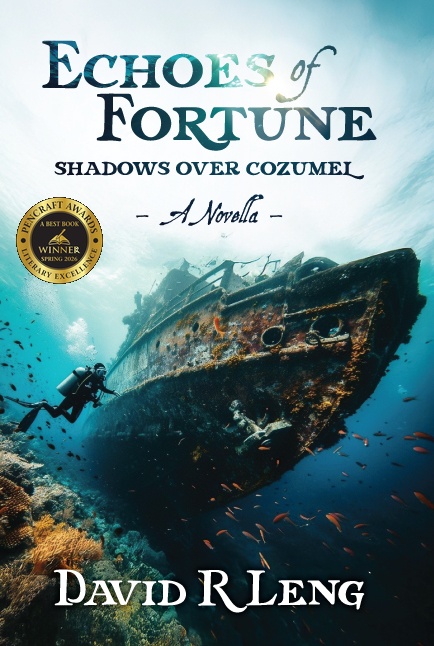
I send these every so often, real history and the legends that grow out of it, and sometimes a cipher to break. Start with the free novella, Shadows Over Cozumel, and I will send the next dispatch straight to you.
Get the free novellaUntil next time, keep hunting.
David R Leng
Echoes of Fortune. The Past Refuses to Stay Buried… It Echoes into the Present.